As India prepares to host the inaugural Global Big Cat Summit 2026, the eyes of the conservation world are firmly on the Bengal Tiger. For families, this landmark year offers a unique opportunity to witness one of the world’s greatest conservation success stories. However, taking young children into the heart of tiger country requires a shift in mindset: moving away from the “high-speed chase” of sightings and toward a holistic, ethical immersion in the wild.
In 2026, ethical tiger tourism is defined by “The Quiet Safari”—a commitment to low-impact viewing, scientific contribution, and fostering a lifelong respect for nature in the next generation.
1. Choosing the Right Park: The Family-First Selection
Not all tiger reserves are created equal when it comes to traveling with children. While fame often draws crowds to Ranthambore, families in 2026 are finding better value and lower stress in the “Central Heart” of India.
- Kanha National Park (Madhya Pradesh): Often cited as the inspiration for Kipling’s The Jungle Book, Kanha is ideal for kids. Its vast open meadows (maidans) offer high visibility, meaning children don’t have to strain their eyes through dense brush. It is also the only home of the Barasingha (swamp deer), a conservation miracle your children can see up close.
- Satpura National Park: For families with active older children (or those who want to avoid the “jeep-only” fatigue), Satpura is a revelation. It is one of the few reserves where you can engage in canoeing and walking safaris in the buffer zones. This varied pace is perfect for keeping young minds engaged when a tiger is being elusive.
- Bandhavgarh National Park: If your children have a shorter “attention window,” Bandhavgarh’s high tiger density increases the odds of a sighting early in the drive. The park also features ancient caves and a hilltop fort, adding a dash of “Indiana Jones” history to the wildlife adventure.
2. The Ethics of the Encounter
The National Tiger Conservation Authority (NTCA) has reinforced strict guidelines for 2026 to ensure that tourism supports, rather than disrupts, feline habitats. An ethical family tour adheres to these three pillars:
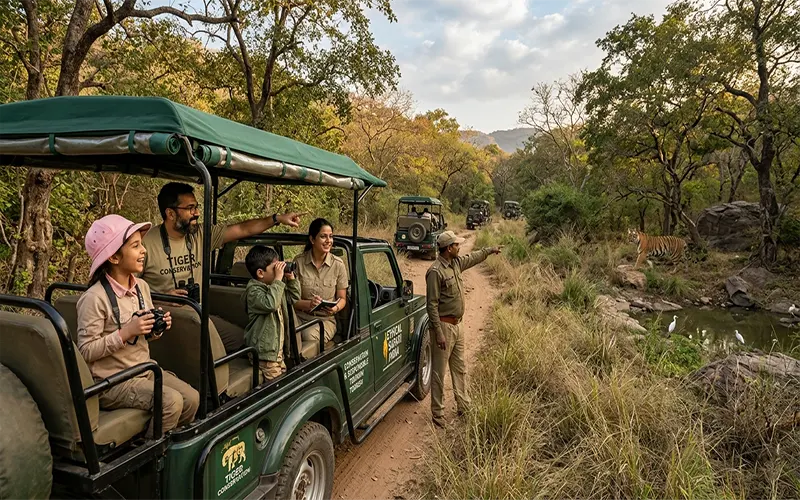
- The 150-Meter Rule: Ethical operators will never “crowd” a tiger. If you see a line of 20 jeeps surrounding one animal, ask your driver to move away. Teaching your children that the tiger’s comfort comes before our photo is the most important lesson of the trip.
- Silence as a Skill: In 2026, many parks are piloting “Silent Zones” where mobile phones and loud talking are strictly prohibited. Challenge your children to a “forest listening” game—see who can identify a Langur’s alarm call or the rustle of a Sambhar deer first.
- No Baiting, No Shortcuts: Ensure your tour operator is affiliated with TOFTigers or similar conservation alliances that vet lodges for sustainable practices and fair pay for local tribal guides.
3. Junior Naturalist Programs: Education Over Entertainment
The “Junior Naturalist” movement has transformed the family safari. Top-tier lodges, such as those run by Pugdundee Safaris, now offer specialized curricula for children.
Instead of just sitting in a jeep, kids spend their afternoons:
- Pugmark Tracking: Learning to identify the difference between a leopard and a tiger track in the buffer zone sand.
- Butterfly & Bug Walks: Exploring the “micro-safari” of the lodge’s eco-gardens.
- Tribal Storytelling: Meeting local Gond or Baiga naturalists to hear folk tales about the forest, bridging the gap between wildlife and the people who protect it.
4. Logistics for Little Explorers
A successful ethical safari is built on a foundation of smart logistics.
- The Private Jeep Advantage: Always book a private jeep. It allows you to return to the lodge early if a toddler gets restless without ruining the experience for other travelers.
- The “Boredom Buster” Kit: Even in 2026, tiger sightings take patience. Pack a pair of child-specific binoculars, a local bird guidebook, and a sketchpad for them to draw what they see.
- Seasonal Timing: For families, February and March are the “Goldilocks” months. The weather is pleasantly cool, the grass has thinned out for easier sightings, and the intense heat of May (which can be brutal for young children) hasn’t yet arrived.
5. The “Ethics Checklist” for Parents
Before booking your 2026 tour, ask these four questions:
- “Is the lodge solar-powered and plastic-free?” (Most premium eco-lodges in India are now 90% plastic-free).
- “Does the lodge hire from the local community?” (This ensures your tourist dollars directly prevent poaching by providing local employment).
- “Are your naturalists trained in child-specific education?”
- “Do you participate in the 2026 ‘Silent Conversations’ initiative?” (A program focused on minimizing noise pollution in tiger corridors).
Planting the Seeds of Conservation
An ethical tiger safari isn’t just about seeing a predator; it’s about participating in a delicate ecosystem. When a child sees a tiger through binoculars from a respectful distance, they aren’t just seeing an animal—they are seeing a reason to protect the planet. By choosing a tour that values ethics over “the chase,” you are ensuring that when your children grow up, there will still be a wild India for their children to explore.