
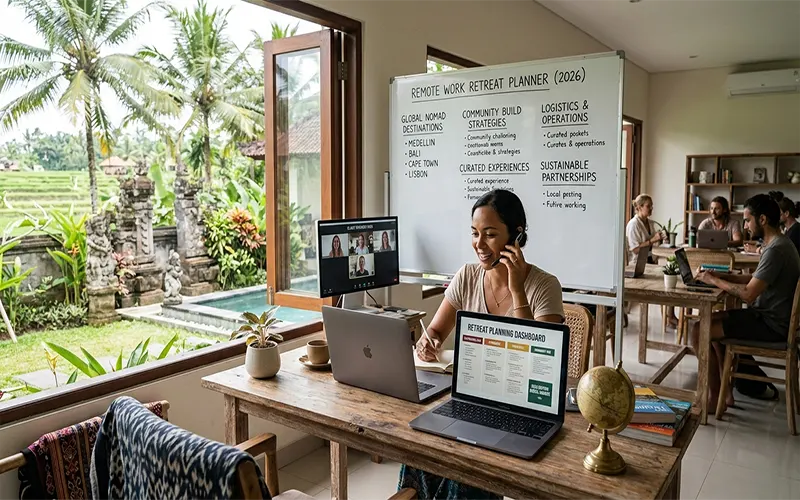
In 2026, the image of the digital nomad as a solo traveler with a laptop on a beach has been replaced by a more sophisticated reality. The modern remote worker is no longer just looking for a getaway; they are seeking Workation Hubs—environments where professional productivity and high-level community are seamlessly integrated.
With the global nomad services market exceeding $54 billion this year, the role of a Remote Work Retreat Planner has moved from a niche hobby to a high-demand professional service. If you are looking to build a business that combines logistics, community building, and travel, this is your blueprint for success.
1. The 2026 Market Opportunity: Beyond the “Big Three”
While Bali, Lisbon, and Medellin remain popular, the 2026 market has shifted toward Secondary Cities and Emerging Hubs. Nomads are fleeing the over-tourism and rising costs of traditional hotspots in favor of “high-value” destinations like Tirana (Albania), Bansko (Bulgaria), and Cape Town (South Africa).
The opportunity for a planner lies in Site Auditing. As a “Retreat Architect,” your value is in vetting destinations that offer the “Nomad Trifecta”:
- Connectivity: Consistent 5G or Starlink availability.
- Cost of Living: High quality of life vs. affordable accommodation.
- Legal Ease: Proximity to countries offering official Digital Nomad Visas.
2. The Four Pillars of a High-Performance Retreat
A successful 2026 retreat isn’t measured by the excursions; it’s measured by the Output. Your planning should be built on these four pillars:
I. Infrastructure Over Aesthetics
In 2026, the #1 cause of retreat failure is “video-call anxiety.” Your primary job is ensuring that every attendee can perform their 9-to-5 without friction.
- Redundant Internet: You must verify at least two independent internet lines (e.g., fiber + Starlink backup).
- Ergonomics: Providing “zoom-ready” backgrounds, noise-canceling pods, and ergonomic chairs is now a baseline requirement, not a luxury.
II. Community Curation
The “magic” of a retreat is the synergy between participants. Rather than an open-invite model, 2026 planners are using Vetting Protocols.
- Professional Matching: Curate groups based on industry or goals (e.g., a “SaaS Founders Retreat” or a “Creative Directors Deep-Work Week”).
- Synergy Interviews: A 15-minute onboarding call helps ensure that the social dynamics will be supportive rather than distracting.
III. The “Slow Travel” Ethos
Brief 3-day retreats are out; 2-week to 1-month “Residencies” are in. This duration allows participants to find a work-life rhythm, overcome jet lag, and actually contribute to the local community rather than just passing through.
IV. Wellness Integration
Productivity in 2026 is linked to well-being. Modern retreats include integrated “Bio-Hacking” or “Digital Detox” elements, such as scheduled forest bathing, morning movement sessions, or catered meals designed for sustained cognitive focus (omega-3s, low-glycemic index).
3. The Planner’s Tech Stack: Scaling with Agentic AI
As a solo founder, you cannot manually manage 20 different time zones and visa requirements. You must leverage Agentic AI—autonomous agents that handle the administrative “heavy lifting.”
- Visa Agents: Use AI tools that track the ever-changing Digital Nomad Visa regulations in real-time, automatically alerting your attendees to required documentation for their specific nationality.
- Dynamic Scheduling: AI agents can analyze the working hours of all attendees (who may be serving clients in London, New York, and Tokyo) to find the “Perfect Window” for communal dinners or networking workshops.
- Budget Tracking: Use agentic workflows to monitor currency fluctuations and adjust the retreat’s local procurement budget automatically.
4. Business Models: How to Monetize
There are two primary ways to structure your 2026 retreat business:
- The B2C All-Inclusive Model: You charge individuals a flat fee (e.g., $3,500 for 3 weeks) that covers boutique co-living, a dedicated workspace, local transport, and curated networking.
- The B2B “Distributed Team” Model: Many startups in 2026 no longer have offices; they have “Retreat Budgets.” You act as an outsourced “Chief of Staff,” planning quarterly off-sites for remote teams to bond in person and tackle high-level strategy.
5. Legal, Compliance, and Insurance
The regulatory landscape for remote work has tightened.
- Insurance: Every attendee should be required to have nomad-specific insurance (like SafetyWing), which covers not only health but also equipment theft and “interruption of work” due to infrastructure failure.
- Liability: Ensure your contracts clearly define that you are a “Logistics Planner” and not an “Employer,” to protect yourself from international labor law complications.
6. Sustainability and “Ethical Gentrification”
2026 has seen a backlash against nomads in cities like Lisbon. As a planner, your “Social License to Operate” depends on how you benefit the host community.
- The “Local-First” Rule: Use local caterers, hire local naturalists for tours, and consider a “Community Give-Back Day” where attendees mentor local students or entrepreneurs.
- B Corp Alignment: Pursuing a B Corp Certification for your agency signals to high-end clients that your business prioritizes environmental and social impact alongside profit.
From Tour Guide to Experience Architect
Becoming a remote work retreat planner in 2026 is no longer about booking hotels; it is about designing environments where people can thrive. By focusing on infrastructure, curating high-level professional communities, and utilizing AI to scale your operations, you can build a business that defines the future of work. In this new economy, the ultimate luxury isn’t a five-star hotel—it’s a perfectly optimized month of work in a place that feels like home.