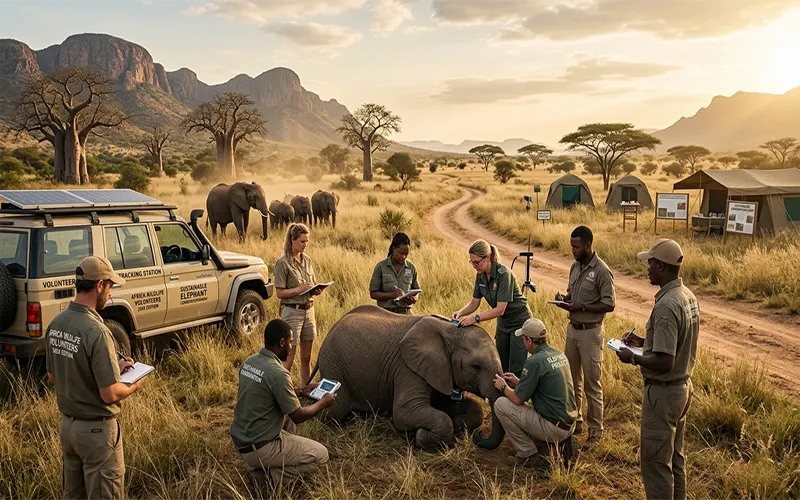
In 2026, the era of “voluntourism”—characterized by high-gloss selfies and hands-on interaction with captive predators—is effectively over. The modern traveler has evolved into a Citizen Scientist, seeking programs where their presence is a mechanical necessity for conservation rather than a marketing byproduct.
Sustainable wildlife volunteering in 2026 is defined by “Impact over Optics.” It is repetitive, scientifically rigorous, and centered on the principle that the best interaction with a wild animal is no interaction at all.
1. The 2026 “Gold Standard” of Volunteering
True sustainability in 2026 is measured by three non-negotiable pillars:
- The No-Contact Rule: Ethical programs, such as those led by Wildlife ACT, strictly prohibit petting, bottle-feeding, or “walking with” big cats. These practices render animals unfit for the wild and are a hallmark of exploitative “cub-petting” industries.
- Science-Led Objectives: Your role is to assist professional field teams in data collection. This includes telemetry tracking, camera trap maintenance, and recording animal behavior for protected area management.
- Financial Transparency: Sustainable packages in 2026 clearly disclose how volunteer fees are used—typically funding fuel for patrol vehicles, anti-poaching equipment, and local ranger salaries.
2. Top-Tier Conservation Models for 2026
The Rhino Protection Model (South Africa)
Programs like Wildlife ACT (operating in the Zululand region) are the benchmark for endangered species monitoring.
- The Work: You’ll spend your days in an open tracking vehicle, using radio telemetry to locate collared rhinos, wild dogs, and cheetahs.
- The Impact: Volunteers provide the “early warning system.” By identifying snares or injuries early, you allow veterinary units to intervene before a loss occurs.
The Marine Megafauna Model (Mozambique)
On the Mtwara and Inhambane coasts, organizations like the Marine Megafauna Foundation (MMF) utilize volunteers for reef health and shark research.
- The Work: Activities include photo-identification of whale sharks and manta rays (using unique spot patterns) and mapping seagrass beds critical for dugong survival.
- The Requirement: While some roles are land-based, many require PADI Open Water certification, which can often be obtained locally at the start of a 4-to-6-week placement.
The Community-Led Conservancy Model (Kenya)
The Northern Rangelands Trust (NRT) model has become the global gold standard for 2026. This is not about “saving” animals from a distance; it is about supporting the indigenous communities who live alongside them.
- The Work: Assisting in “grazing governance” and rangeland restoration. Volunteers help local Samburu or Maasai rangers track elephant corridors to mitigate human-wildlife conflict.
- The Impact: This model proves that conservation only works when it is profitable and safe for the local people.
3. Vetted Volunteer Packages: 2026 Comparison
| Project Focus | Key Partner | Region | Min. Stay | Primary Goal |
| Endangered Species | Wildlife ACT | South Africa | 2 Weeks | Telemetry & Anti-Poaching |
| Marine Research | MMF / GoEco | Mozambique | 4 Weeks | Whale Shark Photo-ID |
| Primate Protection | African Impact | Rwanda | 3 Weeks | Habitat Reforestation |
| Big 5 Research | IVHQ | Greater Kruger | 2 Weeks | Habitat Maintenance |
4. Vetting Your Program: The 2026 “Red Flag” Checklist
Before you commit your time and money, ask the following questions. If the answer to any of these is “Yes,” walk away.
- Can I touch, hold, or feed the animals? (Legitimate conservation never allows this).
- Does the program guarantee a specific “sighting”? (Wild animals are unpredictable; a guarantee suggests they are being baited or kept in enclosures).
- Are there no local staff in leadership positions? (Sustainable programs prioritize local expertise and employment).
- Is there a lack of scientific publications? (Ask where the data you collect is going. If it isn’t being used by a University or a National Park authority, it’s a tourism product).
5. Logistics for the Field
- Insurance: In 2026, standard travel insurance often excludes “field work.” Ensure you have a policy like SafetyWing’s Nomad Insurance, which covers remote medical evacuation.
- The “Digital Fast”: Many 2026 camps are intentionally low-connectivity. This is designed to keep you focused on the environment and the data. Embrace the lack of Wi-Fi as part of the “re-wilding” process.
- Vaccinations: Beyond standard boosters, rabies and yellow fever certifications are often mandatory for those working in close proximity to wildlife corridors.
From Volunteer to Long-Term Advocate
The most important result of a sustainable conservation trip isn’t the work you do during your two-week stay; it’s the perspective shift you take home. In 2026, the goal is to move from being a “one-time visitor” to a lifelong advocate for biodiversity. When you return home, your role is to use the data you saw and the stories you heard to support the policy changes and funding that will protect these landscapes for the next generation.