There is a persistent myth that the Swiss Alps are reserved for elite mountaineers and iron-willed athletes. While the jagged peaks of the Eiger and Matterhorn certainly offer those challenges, the true magic of the Alps in 2026 lies in its accessibility. With a world-class infrastructure of cable cars, electric lake shuttles, and meticulously marked trails, the “Turquoise Magic” of Switzerland is now within reach for any beginner.
If you are looking to combine the tranquility of paddling with the panoramic rewards of a mountain hike, here is your beginner-friendly blueprint for a summer adventure.
1. The Interlaken Hub: Kayaking the Turquoise Gem
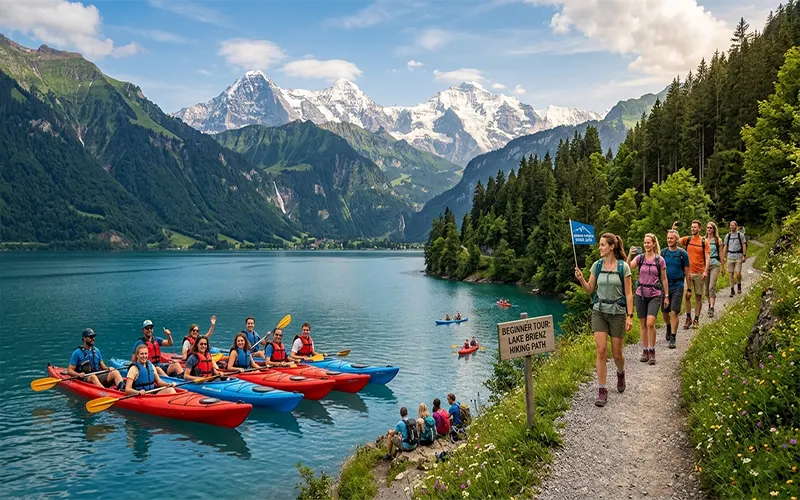
Interlaken remains the undisputed capital of Swiss adventure, situated between two stunning lakes. For beginners, Lake Brienz is the standout choice. Its intense turquoise color—a result of tiny glacial particles reflecting the light—makes it feel like you are paddling through a liquid gemstone.
- The Kayak Experience: Starting from the Hightide Kayak School in Bönigen, beginners can join a guided 3-hour tour. These sessions are designed for those who have never held a paddle. You’ll glide past the 12th-century Ringgenberg Castle and along sun-drenched cliffs that drop vertically into the water. In 2026, many of these tours use stable, wide-base kayaks that are nearly impossible to flip, allowing you to focus on the scenery rather than your balance.
- The “Hike-to-Falls” Pairing: After your morning paddle, take the lake steamer (free with many local guest cards) to the Giessbach Falls stop. From here, a gentle 20-minute forest path leads you to the historic Grand Hotel Giessbach. You can hike directly behind the thundering waterfall on a secure, paved gallery—a high-reward experience with almost zero elevation struggle.
2. Central Switzerland: Lake Lucerne and the “Swiss Path”
Lake Lucerne (Vierwaldstättersee) offers a more fjord-like atmosphere, with steep mountains rising directly from the deep blue water.
- Paddling from Brunnen: The “Urnersee” (the southernmost arm of Lake Lucerne) is legendary. Beginners should head to Brunnen, where the waters are typically calmer in the morning. Renting a kayak here allows you to explore the Schillerstein—a massive natural rock monument dedicated to the author of William Tell—accessible only by water.
- The Weg der Schweiz (Swiss Path): This trail was designed to be inclusive. Section 1, from Rütli to Seelisberg, offers a well-maintained path with spectacular views of the lake. While there is some uphill, the trail is wide and shaded. For a truly “beginner” version, take the funicular up to Seelisberg and hike down toward Bauen, where you can catch a silent electric ferry back to your starting point.
3. The “Gondola-to-Lake” Strategy: Lake Oeschinen
If you want the quintessential “cows with bells and snow-capped peaks” experience without a six-hour climb, Kandersteg is your destination. Lake Oeschinen is a UNESCO World Heritage site and arguably the most beautiful lake in the Alps.
- The Easy Ascent: Instead of hiking up from the valley (which is steep), take the Oeschinen Lake Gondola. From the mountain station, it is a flat, easy 25-minute walk through pine forests to the lake.
- Rowing in the Clouds: At the lake, you can rent rowboats or kayaks. Paddling here is a surreal experience; the water is so clear you can see trout swimming meters below you, and the 3,000-meter peaks of the Blüemlisalp massif reflect perfectly on the surface.
- The Panoramic Loop: For your hike, follow the Heuberg loop back toward the gondola. While it sounds intimidating, the path is wide and safe, offering a “birds-eye” view of the lake you just paddled on.
4. Safety & Logistics for Beginners
Switzerland has perhaps the most organized trail system in the world. Understanding the signs is the key to a stress-free day:
- Yellow Markers (Wanderweg): These are your best friends. They indicate standard walking trails that require no special equipment. The paths are wide, often paved or gravel, and have no steep drops.
- White-Red-White Markers (Bergweg): These indicate mountain trails. They are still beginner-friendly if you have sturdy shoes and a basic level of fitness, but expect narrower paths and some rocky sections.
- The 2026 “Silent Cruise”: As part of Switzerland’s 2030 climate goals, many lake transport ships are now fully electric. This means your transition from hiking to the boat is quieter and more peaceful than ever before.
5. Beginner’s Packing Checklist
- Footwear: You don’t need heavy mountaineering boots for yellow trails, but “trail runners” or sturdy sneakers with good grip are essential.
- The Layers: Even in July, the breeze on a glacial lake can be chilly. Pack a lightweight windbreaker.
- Sun Protection: The Alpine sun is significantly stronger at high altitudes. Apply SPF 50, even on cloudy days.
- Water Temperature: Remember that these lakes are glacier-fed. Even if the air is 25°C, the water might be 12°C. Always wear the provided buoyancy aid (PFD) while kayaking—it provides both safety and insulation.
A summer holiday in the Swiss Alps doesn’t have to be a test of endurance. By choosing the right “hub” lakes like Brienz or Lucerne and utilizing the ingenious network of gondolas, you can spend your morning paddling through turquoise waters and your afternoon strolling through wildflower meadows. In 2026, the Alps are wide open—no crampons required.